
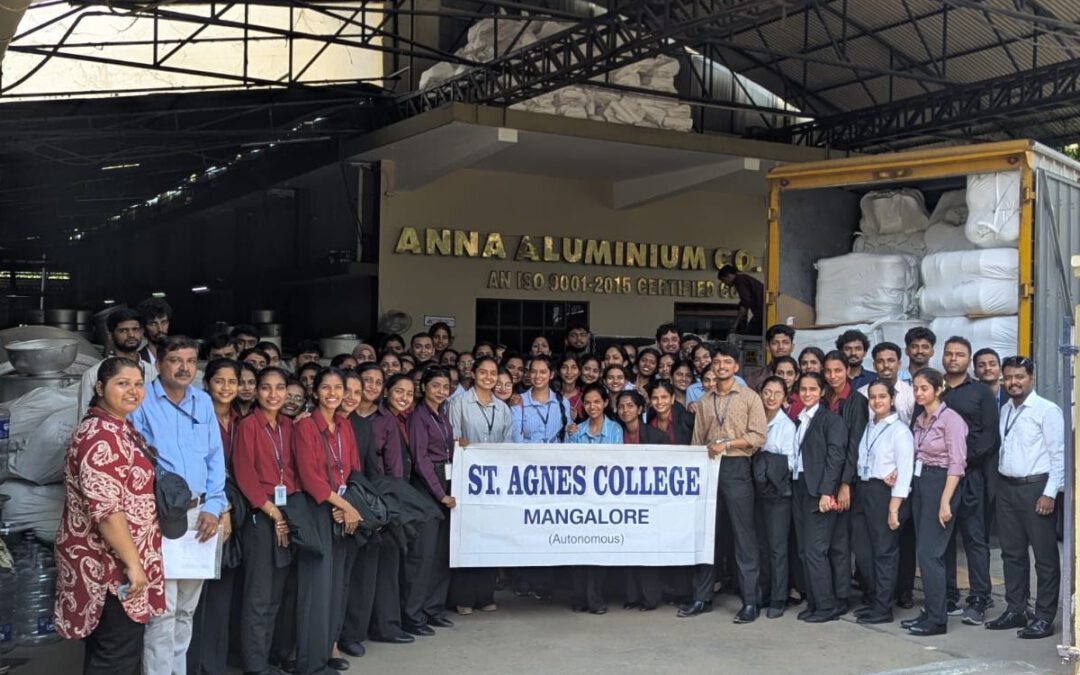
Anna Aluminium Company Pvt Ltd
Name of the Activity: Industrial Visit to Anna Aluminium Company Pvt Ltd
Date of the Activity: 26 March 2026
On the first day of our industrial tour, we visited Anna Aluminium Company Pvt. Ltd., located in Kizhakkambalam near Kochi. The purpose of this visit was to gain practical exposure to manufacturing operations and understand how concepts from operations and supply chain management are applied in a real industrial setting. Established in 1968 by Mr. M. C. Jacob, the company is a well-known manufacturer of aluminium products such as kitchen utensils, pressure cookers, idli makers and milk cans, with a strong reputation for quality and durability.
During the visit, we observed the complete production process, which begins with aluminium ingots being melted and converted into sheets, followed by shaping through heavy machinery. While automation was used in major stages, several processes such as hole-making, handle fixing, assembly and polishing required skilled manual intervention. Material handling equipment like forklifts supported internal movement and the workflow appeared well-planned and organized. The workforce structure showed a clear division of labor, with women engaged in precision-based tasks and men handling more machine-intensive operations. The facility maintained a clean and efficient environment, with proper safety measures such as machine instructions, diagrams and protective practices in place. We also observed quality testing processes, including heat resistance checks, ensuring product durability. Additionally, aluminium waste generated during production was systematically collected and likely recycled, reflecting efficient resource utilization. The company’s ISO 9001 certification further indicates adherence to standardized quality management practices.
Overall, the industrial visit was highly informative and provided meaningful insights into real-world manufacturing systems, workforce coordination and quality control practices. It helped bridge the gap between theoretical knowledge and practical application, enhancing our understanding of industrial operations and management. The experience was valuable in developing a clearer perspective on how structured processes and efficient resource management contribute to organizational performance.
Shipyard Visit
Name of the Activity: Industrial Visit to Shipyard
Date of the Activity: 26 March 2026
Write-up about the Programme:
On 26 March 2026, as part of our industrial visit, we attended an informative session at Vypin Shipyard Pvt. Ltd., Kochi, followed by practical exposure at the site. The session was conducted by Mr. Tojen E., General Manager (Operations), who introduced us to the importance of ships in logistics and global trade. He also shared valuable career insights, emphasizing the need for curiosity, continuous learning and the ability to ask the right questions in order to grow in the logistics and shipping industry.
During the session, we learned about different types of ships such as cargo ships, container ships and carrier vessels, each designed for specific transportation needs. Mr. Tojen E. explained key components of a ship, including the radar system used for navigation, the cargo hold where goods are stored and the draft markings on the ship’s side used to measure depth and ensure safe loading. We also observed mooring lines and fenders used to secure ships at the dock. At the shipyard, we witnessed cargo handling operations such as loading and unloading using cranes, storage and movement within the port and visited a docking area where a ship was undergoing maintenance. The session concluded with an interactive question-and-answer session that enhanced our understanding through practical insights.
Overall, it was an engaging and enjoyable session that provided valuable on-the-ground learning. The visit helped us understand the role of ships and shipyards in global supply chains, effectively bridging the gap between theoretical knowledge and practical application, while also offering insights into industry practices and career opportunities in the field of logistics and shipping.
Cochin International Cruise Experience
Cruise Experience
Date of the Activity: 26th March, 2026
Write-up about the Programme:
As part of our industrial visit, we had the opportunity to experience a cruise, which offered a unique perspective on maritime operations, tourism and port-based infrastructure. This segment of the visit was both informative and engaging, allowing us to observe key landmarks and gain practical insights into the functioning of a port ecosystem.
During the cruise, we were introduced to several important operational elements of the shipping industry. We observed one of the world’s largest cranes used for handling heavy cargo and containers, which demonstrated the efficiency and scale of modern loading and unloading processes. We also learned about a large cargo vessel with a capacity of up to 4,500 containers, highlighting the immense scale of maritime transportation. Additionally, we saw naval ships stationed in the area, which provided insight into maritime security and the role of naval forces in safeguarding national waters. A notable cultural highlight was the observation of Chinese fishing nets—an age-old fishing technique introduced by Chinese traders—showcasing an early integration of mechanical methods in traditional fishing practices.
The cruise also highlighted the tourism and hospitality aspects of the region. We observed several luxury waterfront hotels that contribute significantly to the local tourism industry, along with a well-known location frequently used for film shootings, making it a popular attraction. These elements illustrated how ports serve not only as centers of trade and logistics but also as hubs for tourism and cultural significance.
Overall, the cruise experience was highly enriching, as it provided a comprehensive understanding of the multiple roles played by ports—ranging from trade and logistics to security and tourism. The visit effectively combined theoretical learning with real-world observation, making it both educational and memorable.
HMT Machine Tools Limited
Name of the Activity: Industrial Visit to HMT Machine Tools Limited
Date of the Activity: 28 March 2026
Write-up about the Programme:
On the second day of our industrial visit, we had the opportunity to visit HMT Machine Tools Limited, a prominent public sector enterprise in the field of heavy engineering and machine tool manufacturing. The objective of this visit was to gain practical exposure to large-scale manufacturing operations and to understand the functioning of machinery, production systems and industrial management in a real-world environment.
Established in 1964, HMT has played a significant role in the development of India’s engineering sector. The company is known for manufacturing machine tools and capital goods and was historically recognized for its clocks and watches. A key strength of HMT is its emphasis on self-reliance, as many of the machines used within the facility are manufactured in-house. This reflects strong engineering capabilities and a commitment to indigenous production. Upon entering the premises, we observed strict security protocols, highlighting the importance of discipline and safety in industrial settings. The facility comprises multiple specialized departments, including machining units, gear and mechanical sections, assembly lines, electrical units, testing zones and dispatch areas. The factory also efficiently utilizes vertical space to accommodate heavy machinery.During the visit, we observed various stages of the manufacturing process. Components such as gears and mechanical parts were produced in dedicated units, supported by processes like heat treatment to enhance strength and electroplating to improve corrosion resistance and finishing. Precision operations such as screw making and thread peeling were carried out using specialized machines. In the assembly section, machines like lathes were systematically assembled, while electrical units handled wiring and integration. We also learned about feed box assembly, which is essential for controlling the movement mechanisms of machine tools.
An effective coding system was used for identifying components, enabling efficient tracking and inventory management. Quality control was a critical aspect of operations, with regular inspections conducted on key components such as spindles and turrets to ensure accuracy and durability. Post-assembly, machines were tested for performance before final approval and dispatch. The use of advanced technologies, particularly CNC (Computer Numerical Control) machines, was a major highlight, offering high precision, automation and the ability to produce complex components with minimal error. Additionally, laser engraving machines were used for accurate marking and detailing. The company also demonstrated strong maintenance practices, ensuring machines remain efficient over time and utilized cranes for safe material handling of heavy components. Another noteworthy aspect was the focus on sustainability, with scrap metal being recycled within the facility to minimize waste and promote resource efficiency.
Overall, the visit provided valuable insights into heavy engineering manufacturing, machine tool production, industrial safety, quality control and modern technological applications. It effectively bridged the gap between theoretical knowledge and practical implementation, offering a deeper understanding of large-scale industrial operations.


